What do enterprises, mid-sized businesses, and startups have in common?
The answer: An unavoidable need for change.
In today’s fast-paced world, standing still is not an option. Yet, while change is essential for growth, it’s often fraught with uncertainty and challenges.
Navigating it successfully requires a solid strategy. This is where change management comes in.
Put simply, change management is the art and science of steering individuals, teams, and organizations through transformations to achieve meaningful results. It’s about planning, communicating, and supporting transitions to ensure seamless and successful outcomes.
In this article, we’ll explore:
- The key drivers of change
- The cost of poor change management
- Why many change initiatives fail
- Proven tips for successful change management
And we’ll back it all with 72 statistics to guide your strategy.
But first, let’s start with the basics: why is the topic of change so crucial?
General statistics on change management
Change in business is constant.
Whether deliberate or instinctive companies are always evolving to meet external pressures and internal demands.
- Research shows that 79.7% of organizations should revamp their business strategies every 2–5 years to keep up with the pace of change (KPMG, 2016).
- It makes sense then that an overwhelming 96% of organizations are in some phase of transformation (KPMG, 2016).
And this trend isn’t slowing down.
- A staggering 73% of organizations anticipate more change initiatives in the next three years, with just 13% expecting fewer (CEB Corporate Leadership Council, 2016).
So what exactly causes change?
In short, global trends, shifting economies, and competitive pressure force businesses to constantly adapt.
- For example, in a survey of 554 professionals, 51% identified growth opportunities in new markets as the leading driver of their digital transformation efforts (Altimeter, 2018).
- Additionally, 41% of organizations name changing customer demographics, behaviors, and expectations as the most influential source of insights for their transformation strategy (KPMG, 2016).
Digitalization also pushes businesses to adopt new tools to stay competitive.
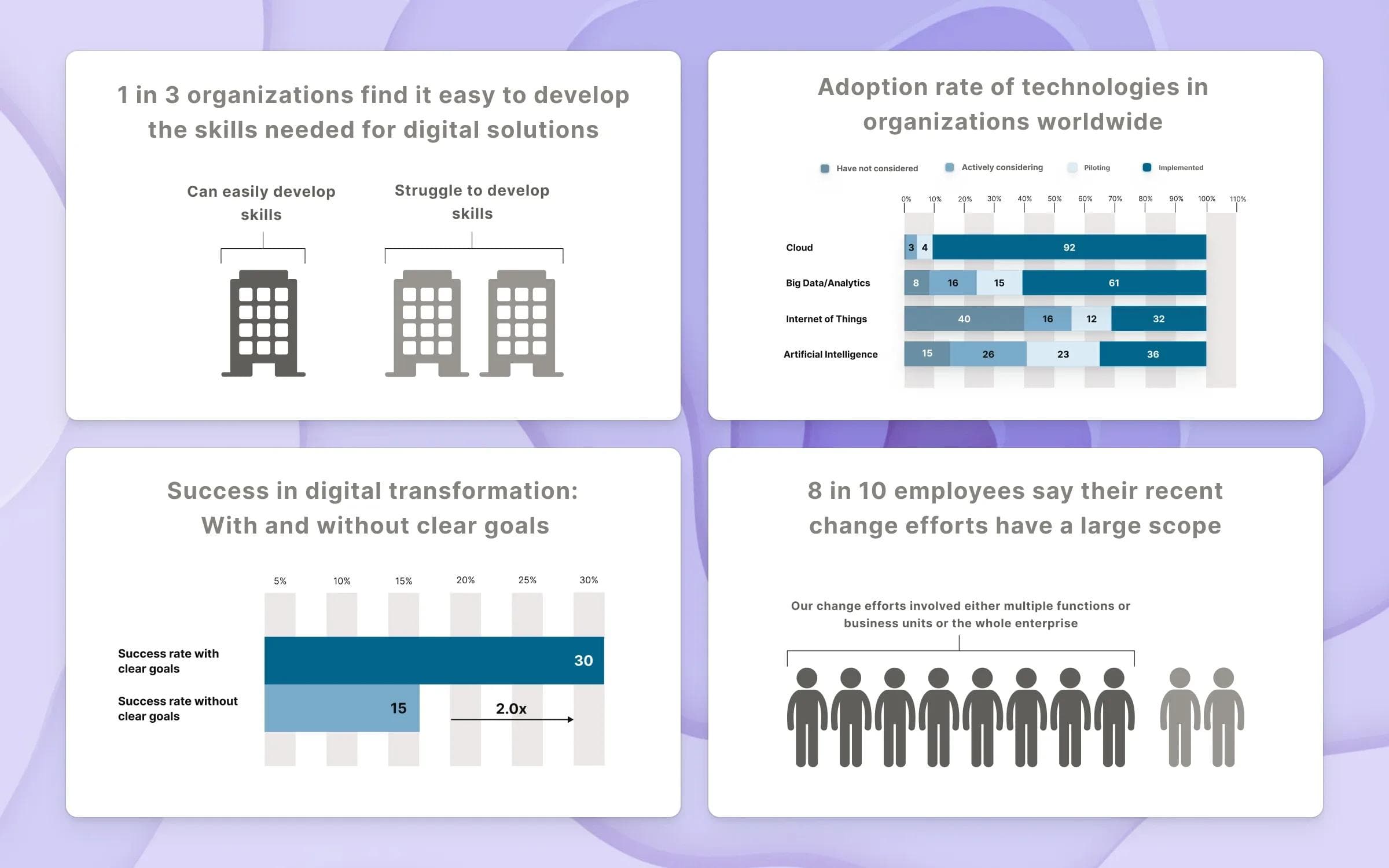
- More than half of respondents in a McKinsey Global Survey reported a digital transformation as their organization’s most recent change effort (McKinsey & Company, 2018).
Change is essential for survival, however, not all change efforts succeed.
The cost of poor change management: Key statistics
Even though change is inevitable, many organizations struggle to navigate it successfully.
- Despite frequent attempts, only 34% of major change initiatives achieve success, even as the average organization undergoes five significant changes every three years (CEB Corporate Leadership Council, 2016).
- Additionally, 1 in 3 CEOs report failing to realize the value expected from transformation efforts (KPMG, 2016).
Consequently, failure in change management is more common than success.
- Overall, 60–70% of change initiatives fail (Errida & Lotfi, 2021).
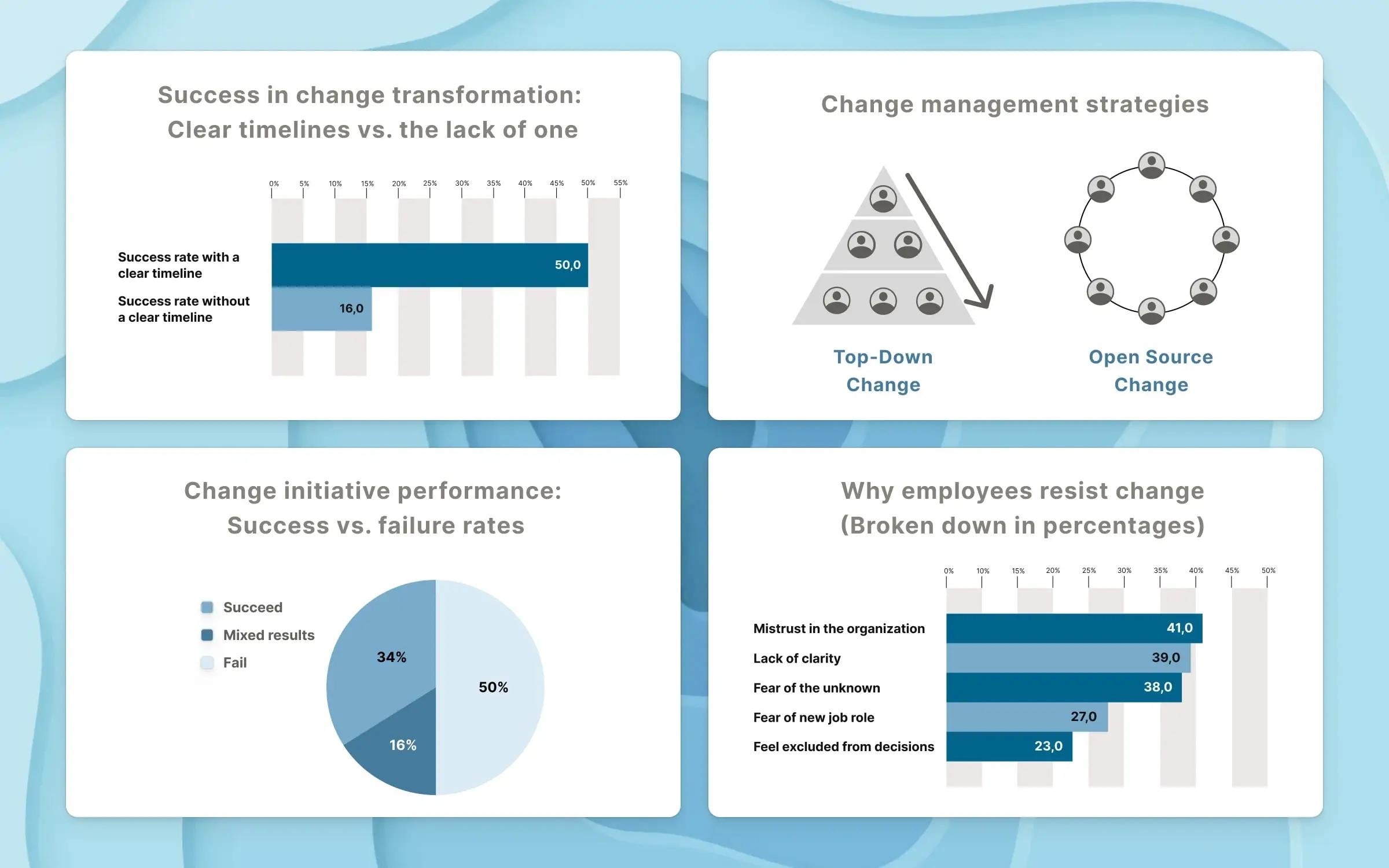
- CEB's 2016 data, the source of the 34% above, splits outcomes into 50% clear failures, 16% mixed results and 34% clear successes (CEB Corporate Leadership Council, 2016).
Surprisingly, doubts about the success of change often stem from leadership.
- Only 17% of executives feel their organizations are highly capable of executing transformational plans (KPMG, 2016).
- And a shocking 50% of leaders cannot confidently assess the success of recent organizational changes (CEB, 2016).
- 31% of executives also admit their organizations lack processes to manage innovation (KPMG, 2016).
- Meanwhile, only 47% of executives believe they can extract and maintain the planned value from a future transformation initiative (KPMG Global Transformation Study, 2016).
- In addition, only 51% of executives believe they can create short-term transformation wins (KPMG Global Transformation Study, 2016).
Employee confidence is also waning:
- Seeing as only 43% of employees believe their organization manages change effectively, down from nearly 60% in 2019 (WTW, 2023).
- The gap between leaders and employees shows up in goal programs too: in a 2026 survey of 187 companies running OKRs (all of them Mooncamp customers), leaders rated OKR impact 4.1 out of 5 and employees at the same companies 2.7, with the widest gap on executing strategy, 4.3 vs 2.4 (Mooncamp OKR & Strategy Execution Report 2026).
These statistics highlight the urgent need for organizations to improve their change management strategies. Without proper management, repeated failures can otherwise cause change fatigue.
📚 Change fatigue: A state of physical or emotional exhaustion caused by frequent or continuous organizational changes, leaving employees feeling overwhelmed and less engaged.
Unfortunately, change fatigue is a growing challenge for many organizations.
- In fact, a 2022 Capterra study found that 71% of employees, including 86% of 16–24-year-olds, feel overwhelmed by the amount of change at work (Capterra, 2022).
- More recent 2024 Gartner data underlines how persistent the trend is: in a July 2024 survey of 473 HR leaders, 73% said their employees are fatigued from change, and 74% said their managers are not equipped to lead change (Gartner, 2024).
This strain can disrupt workplace morale and productivity.
- 48% of change-fatigued employees say they are more tired or stressed at work (Capterra, 2022).
- 37% feel less trust toward their employers after experiencing workplace changes (Capterra, 2022).
- 38% say they enjoy their jobs less than before the changes (Capterra, 2022).
Change fatigue also has a direct impact on employee retention.
- For instance, only 43% of employees with above-average change fatigue intend to stay with their organization, compared to 74% of those with low fatigue levels (Gartner, 2022).
- Another study supports this stating that 54% of change-fatigued employees are considering leaving their jobs (Capterra, 2022).
So poor change management isn’t just about failed initiatives. It can lead to higher employee turnover and long-term instability.
Change management statistics: Pitfalls to avoid
This begs the question: Why do so many change initiatives fail?
- The majority of change initiatives (70%) fail to achieve their goals, primarily due to employee resistance and lack of management support (McKinsey, 2015).
- Management support can also vanish with a change at the top: of the 8 OKR programs we followed that stopped, 6 did so after a new CEO or head of strategy arrived and nobody relaunched OKRs, while at companies where no leader changed, 2 of 22 programs stopped (Mooncamp OKR & Strategy Execution Report 2026).
Unfortunately, employee resistance to change appears to be on the rise:
- Only 38% of employees were willing to support organizational change in 2022, down from 74% in 2016 (Gartner, 2022).
- And despite being capable, only 26% of employees effectively implement change (CEB Corporate Leadership Council, 2016).
This employee resistance seems to be fueled by a lack of management support, creating a vicious cycle where poor support exacerbates resistance, further hindering change efforts.
- Research shows that 83% of employees experiencing change fatigue say their employer has not provided enough tools or resources to help them adapt (Capterra, 2022). That leaves them unprepared and overwhelmed.
- Compounding the issue, 41% of employees cite mistrust in their organization as the primary driver of resistance (Oak Engage, 2023). Without trust, employees are unlikely to engage positively with change efforts.
- Similarly, 39% of employees feel resistant due to a lack of understanding about why the change is happening (Oak Engage, 2023). This hints at a critical gap in communication.
- Fear of the unknown further fuels resistance, with 38% of employees hesitant to embrace change due to uncertainty about its implications (Oak Engage, 2023).
- Another 27% resist change due to possible change of job role (Oak Engage, 2023).
- Lastly, 23% of employees say being excluded from change-related decisions would make them most resistant to change (Oak Engage, 2023).
Another common pitfall is sticking to outdated methods:
- According to KPMG, 37% of executives believe the main hurdle is failing to adapt the operating model enough (KPMG, 2016).
- On the same note, 28% of executives say their existing organizational culture is a barrier to execution (KPMG, 2016).
- And 30% of executives say their organizations’ legacy technology/systems are a barrier to success (KPMG, 2016).
In essence, to avoid stagnation, companies must let go of outdated processes and adopt modern tools, systems, and skills to remain competitive.
However, technology alone isn’t enough. Successful change demands a clear plan or strategy, not just the introduction of new tools.
- According to research, transformations focused on technology rather than strategic goals are 2 times more likely to fail (KPMG, 2016).
As hinted at above, poor communication is another major barrier to change.
- Less than half of executives (49%) consider their organizations capable of communicating regularly throughout a transformation (KPMG, 2016).
- And a different study reports that over 50% of managers and employees say that leaders fail to define clear success metrics for change (CEB Corporate Leadership Council, 2016).
- All the while, 29% of employees state that change is not communicated clearly in their organizations (Oak Engage, 2023).
This is concerning, as a clear link exists between lack of transparency and change fatigue.
- After all, 93% of employees with change fatigue report their employers have backtracked on at least one initiative, causing frustration (Capterra, 2022). Backtracking also causes hesitancy toward future changes.
- Additionally, 64% of employees wait to be told by leaders what to do during change (CEB Corporate Leadership Council, 2016).
Without clear communication and transparency, meaningful steps to implement change are unlikely to happen.
Lastly, a common mistake in change management is relying on a top-down approach to drive change.
- 7 in 10 organizations depend on top-down leadership to guide employees through change (CEB Corporate Leadership Council, 2016).
- Furthermore, 62% of organizations implement leader-driven plans in an attempt to ensure consistency and speed (CEB Corporate Leadership Council, 2016).
However, these leader-driven plans often fall short because leaders lack insight into how change impacts employees.
- A striking 72% of leaders admit they don’t know what employees need to do differently during change due to their disconnection from day-to-day work and shifting priorities (Gartner, 2019).
- 48% of leaders admit they face challenges in spotting market trends and forecasting customer demands (KPMG, 2016).
- And while 74% of leaders claim to involve employees in creating change strategies, only 42% of employees feel they are truly included (Gartner, 2019).
Let’s recap the key pitfalls that weaken change management:
- Lack of management support: Without adequate support, employees distrust the organization, feel uninformed, or fear the unknown, stalling progress.
- Clinging to outdated processes: Holding onto legacy systems or processes prevents organizations from adapting effectively to new challenges.
- Lack of strategic focus: Driving change through new technologies or tools instead of strategy leads to misaligned priorities, wasting resources on tools that don’t address the organization’s core needs or long-term goals.
- Poor communication & transparency: When the reasons for change are unclear, employees become confused and disengaged, leading to frustration and resistance.
- Over-reliance on top-down approaches: A top-down strategy isolates leadership from employee realities, resulting in plans that don’t account for practical challenges. This disconnect can reduce buy-in and create a lack of ownership among employees.
By addressing these pitfalls, organizations can build a stronger foundation for successful change.
Successful change management: Tips + statistics
Now that we’ve identified the challenges in change management, how can organizations avoid them and ensure success?
Start with whether change management pays off at all:
- In Prosci's Best Practices in Change Management study of more than 2,600 change practitioners, 88% of those who rated their change management excellent met or exceeded project objectives, against 13% of those who rated it poor (Prosci).
For one, piloting and prototyping can make a big difference:
- Research by McKinsey shows that companies are 3 times more likely to succeed in digital transformation when they use piloting and prototyping processes to identify necessary new skills (McKinsey & Company, 2018).
A clear timeline is also key to reducing employee uncertainty and fostering transparency.
- 50% of respondents in a McKinsey survey reported success when the implementation timeline was clearly communicated, compared to just 16% when it wasn’t (McKinsey & Company, 2018).
Another tip: Instincts are valuable, but data drives success.
- This is why 44% of executives point to data and analytics as the key drivers and enablers of new business and operating models in their organizations (KPMG Global Transformation Study, 2016).
Continuously analyzing progress and market shifts is essential to staying on track. But, this is often easier said than done. Clear metrics, like KPIs, can make the process easier and help smooth change implementation.
- For example, organizations that track KPIs during change implementation achieve a 51% success rate, compared to just 13% for those that don’t (McKinsey & Company, 2018).
- Beyond tracking KPIs, success is more than 4 times likelier when organizations focus on two other practices: ensuring meaningful change in how they operate after the solution is implemented, and allowing employees to improve and refine the new solution (McKinsey & Company, 2018).
Having a clear plan and well-defined priorities is another cornerstone of successful change management.
- In digital transformations, success is 2.7 times more likely when potential ideas for the digital solution are clearly prioritized (McKinsey & Company, 2018).
Even more important, however, is clear communication.
- In digital transformations, success rates increase 3.5-fold when companies clearly communicate desired outcomes before launching solutions (McKinsey & Company, 2018).
While progress tracking, priority setting, and clear communication are critical, they can be challenging to implement. Luckily, OKRs serve as a useful tool to break down and manage these efforts.
- Over 60% of companies using OKRs conduct regular check-ins, ensuring consistent communication and tracking progress (OKR Impact Report 2022).
- Plus, according to Haufe Talent Research, 72% of employees using OKRs feel more connected to their company’s vision, compared to 50% in organizations without OKRs.
- Additionally, 98% of companies adopting OKRs report improved transparency and alignment (OKR Impact Report 2022).
- How often teams check in matters too: in a 2026 survey of 187 companies running OKRs, those that check in weekly or every two weeks rate OKR impact 3.6 and 3.8 out of 5, against 2.6 for monthly check-ins, and only 83 of the 187 companies (44%) check in every week or two (Mooncamp OKR & Strategy Execution Report 2026).
💡 Want deeper insights into OKRs and their benefits? Then don’t miss out on the full OKR Impact Report 2022 for all the details.
As mentioned earlier, most change initiatives are introduced top-down. In such cases, leaders have to take responsibility and properly guide employees through the process.
- As a matter of fact, 74% of employees think leaders need to do more to understand why people resist change, and 45% of them say it would make people more productive (Oak Engage’s Change Report, 2023).
A critical factor for successful change, however, is the level of employee involvement in the process.
- When employees are genuinely invested in change, it is 30% more likely to stick, emphasizing the need to engage and support staff throughout transitions (McKinsey & Company, 2015).
- Involving employees in decision-making also improves the success rate of change initiatives by 15% (Gartner, 2022).
- At the same time, shifting implementation planning to employees raises the probability of success by as much as 11 percentage points (CEB Corporate Leadership Council, 2016).
- Letting teams propose their own goals pays off as well: in a 2026 survey of 187 companies running OKRs, companies where leaders set the priorities and teams propose their own OKRs score 3.4 out of 5 on executing strategy and 4.0 on team focus, against 2.4 and 2.9 at companies that hand OKRs down in a strict top-down cascade (Mooncamp OKR & Strategy Execution Report 2026).
If you want to get employees more involved and less resistant, an open source strategy is worth considering.
📚 Open source strategy: A strategy that actively engages employees and other stakeholders in creating and implementing change initiatives. Instead of top-down directives, it emphasizes collaboration, transparency, and shared ownership, allowing everyone to contribute ideas and solutions.
Here’s what the numbers say about open source strategies:
- An open source strategy can raise the probability of change success by as much as 24 percentage points (CEB Corporate Leadership Council, 2016).
- Change implementation time also decreases by as much as 1/3 with an open source strategy (CEB Corporate Leadership Council, 2016).
- Plus, employee time spent on change decreases by as much as 12.6 hours per week per employee (CEB Corporate Leadership Council, 2016).
- Employee engagement rises by as much as 38 percentage points (CEB Corporate Leadership Council, 2016).
- Discretionary effort (the willingness to go above and beyond) also rises by as much as 19 percentage points (CEB Corporate Leadership Council, 2016).
- The share of employees who feel ownership for making the change successful rises by as much as 29 percentage points (CEB Corporate Leadership Council, 2016). These benefits likely stem from that increased ownership.
How does this compare to top-down strategies?
- With top-down strategies, only 20% of the workforce understands the change they face. On the other hand, with open source talk communication, 54% of the workforce understands the change (CEB Corporate Leadership Council, 2016).
But an open source strategy doesn’t mean leaving employees to their own devices.
Successful organizations find a balance. They give employees the freedom to try new ideas and solutions but also set rules to make sure everything stays on track with the overall change plan (Gartner, 2019).
Conclusion
Change is inevitable, but navigating it doesn’t have to be overwhelming.
Statistics show that the key to successful change lies in clear communication, thoughtful planning, testing strategies, and ensuring employees are actively involved. When employees feel heard, supported, and included, they are more likely to embrace change rather than resist it.
The data also highlights the advantages of using modern tools and technology. Tools like OKRs can simplify setting clear goals, tracking progress, and adjusting plans, steps that significantly improve the chances of successful change.
Organizations that focus on these elements are much more likely to reach their goals and avoid the 60-70% failure rate common in many change initiatives: in the studies above, each of these practices goes with a higher reported success rate.
By combining employee involvement, open communication, and the right tools and technology, change can shift from being a challenge to an opportunity for growth.
Want to know more about keeping your team aligned and thriving during change? Explore our blog for more tips and insights.