Successful companies know that the only way to stay competitive in the future is to set clear goals. However, managing a team effectively requires more than just setting goals.
- The gap OKRs don't fill: OKR check-ins and reviews are team meetings. CFR (Conversations, Feedback, Recognition) adds the individual coaching layer that teams need
- CFR replaces annual reviews: Regular 1:1s focused on growth take the place of the annual performance review. The goal is future improvement, not past judgment
- Recognition is specific: Recognize concrete contributions as they happen, from managers and peers, instead of naming an "employee of the month"
- Keep it face-to-face: Hold CFR conversations in person or by video call where you can, so facial expressions and tone come through
Good performance management serves both the organization's goals and each person's growth. Peter Drucker, known as the "father of modern management", believed that effective performance management must be tailored to both the needs of the organization and the growth of individuals. That takes an interpersonal approach, a culture of trust and open communication, which is why many companies pair OKRs with CFR.
This article explains what these two abbreviations stand for, how CFR works, and why OKRs and CFRs are the perfect match.
What to expect:
- What is CFR?
- How does CFR work?
- How OKRs and CFR work together
- Combining OKRs and CFR: Tips and best practices
- Conclusion: CFR + OKR = the perfect match
- OKRs and CFR: FAQ
What is CFR?
“CFR” stands for “Conversations, Feedback, and Recognition”, the communication layer John Doerr pairs with OKRs. Conversations happen in one-on-ones and team meetings throughout the cycle, feedback flows both ways and among peers, and recognition comes from managers and peers alike (What Matters).
It consists of three elements, according to John Doerr in “Measure What Matters”:
- 💬 Conversations: Employees have an open and candid one-on-one exchange with their manager to improve their individual performance.
- 👍 Feedback: Self-perception and the perception of others are aligned through two-way communication within the team, allowing employees to grow individually.
- 🏆 Recognition: Contributions of all sizes are acknowledged as they happen, by managers and by peers.
Overall, CFR is a communication system that fosters continuous improvement. It helps gather constructive feedback, recognize good performance, and move the entire team forward. As a tool for continuous performance management, CFR is an alternative to the traditional annual performance review, and many organizations are moving that way (What Matters). In most cases, CFR is integrated into an OKR system.
How does CFR work?
To understand how CFR works, it is worth taking a closer look at its three elements.
Conversation
Performance management’s main affliction is the annual performance review. However, CFR replaces this particular crux with a series of short conversations. The focus is still on individual performance, but the conversations are more informal, open, and solution-oriented. Managers take on a coaching role, as they help their employees achieve their goals and grow. They stay up to date on operational issues and encourage employees to reflect on their performance and improve themselves. This process is therefore future-orientated.
One-on-one conversations focus on questions such as:
- What are you working on right now?
- How are you doing? How are you doing with your goals (e.g., OKRs)?
- Is there anything that is holding you back in your work?
- What do you need from me to be (even) more successful?
- What (e.g., skills) should you work on to achieve your career goals?
- Are you pursuing the right goals? Are they motivating?
Feedback
If you don't know how you're performing at the moment, you can't improve. That's why feedback on your performance is essential. Good feedback is always timely, constructive, specific, and multi-directional. It should not be a one-way street leading top-down from management to employees. Instead, feedback should be shared openly and honestly within the team – whether peer-to-peer or between employees and managers. The goal is to have an open dialogue through which everyone in the team can learn from and grow.
Recognition
Recognition is probably the most underestimated component of CFR. Yet it has been proven time and again that recognition can significantly increase employee engagement and prevent employee turnover. Recognition should always be sincere and performance-based. That is, praise should not be lavished simply for the sake of praise where there is nothing (or little) to praise. Name the specific contribution and what it moved, rather than handing out a generic “employee of the month” title.
To implement CFR effectively, the following applies when it comes to recognition:
- Encourage peer-to-peer recognition. Individual performance should be celebrated within the team.
- Establish clear criteria for what constitutes “good performance”– for example, completing a project, achieving a corporate goal, or strongly contributing to the company’s values.
- Share recognition stories in (internal) newsletters or blogs. This makes the recognition even more meaningful.
- Celebrate small successes – for example, when someone has gone the extra mile to meet a deadline. This shows employees that their efforts are not taken for granted.
How OKRs and CFR work together
Now, you might think that the OKR cycle already provides enough opportunities for feedback and open conversations – for example, in the weekly OKR check-ins or in the OKR review and retrospective. So why do you need CFR? The answer is simple: Because all events in the OKR cycle are team meetings, but a team also consists of individuals with different needs.
💡 Reminder: OKR (short for “Objectives and Key Results”) is an agile framework for formulating and implementing strategic goals in organizations that consists of three core elements:
- Objectives: What do I want to achieve?
- Key Results: How do I know the goal has been reached?
- Initiatives: How do I achieve the goal?
As a rule, 2 to 4 Objectives are formulated per team and 2 to 4 outcome-driven Key Results per Objective. The output is mapped into initiatives (= specific tasks). More information is available in our OKR guide.
CFR gives OKRs a personal and human component. The motivation that arises at the team level through the Objectives and Key Results is carried over to the individual level with CFR. CFR helps motivate all employees and link individual performance to company and team goals.
John Doerr, who introduced OKRs at Google, sums it up this way in “Measure What Matters”:
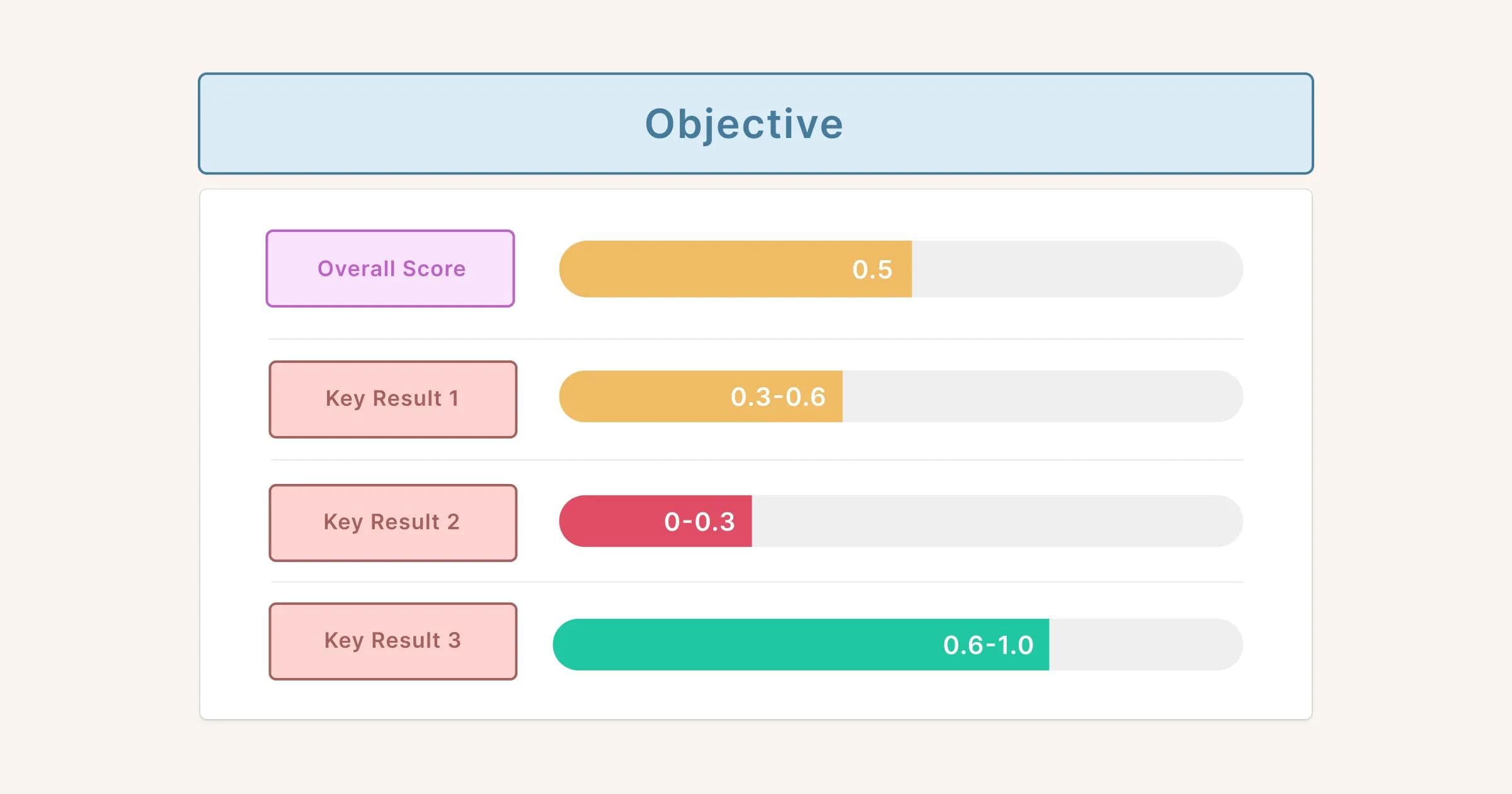
In addition, an OKR's grade only says whether it was achieved, and to what degree (What Matters; see also OKR scoring). CFRs add individual touches to the relatively straightforward definition of success associated with OKRs and expand the vocabulary used to express what progress has been made.
Conversations, feedback, and recognition should therefore take place face-to-face where possible, preferably in person or, for remote teams, via video call. That way, the information conveyed between the lines through facial expressions, gestures, and tone comes through.
Continuous Performance Management with OKRs and CFR
Moreover, healthy continuous performance management can emerge from the combination of OKRs and CFRs. This is based on the following common characteristics of OKRs and CFRs:
- Achievements are continuously recognized and valued.
- Goals are discussed periodically.
- Employees and managers exchange constructive feedback.
- Performance is reviewed regularly in discussions.
- There is a drive to continuously improve.
While OKRs target performance at the company or team level, CFR covers employees' individual career and development goals. The status of the OKRs for which employees are responsible may, of course, be included in the one-on-one conversations. However, the achievement of Objectives and Key Results should not play a role in individual performance management. Above all, OKRs should not be linked to financial incentives.
💡 Tip: If you want to delve deeper into the topic of (continuous) performance management, you should also take a look at our article “OKR and Performance Management: How they work together”.
Combining OKRs and CFR: Tips and best practices
The principle behind OKRs and CFRs is simple. In practice, however, it can be quite tricky to combine the two. That's why we've put together some tips and best practices to help you make the best use of CFRs and OKRs in your day-to-day work:
- Schedule meetings in advance: Having a pre-defined timeline ensures that meetings actually take place and become common practice.
- Listen actively: Managers should listen carefully to their employees and create an atmosphere in which positive feedback, as well as negative feedback, can be discussed openly.
- Give feedback in a constructive way: Feedback sessions should focus on employee performance, not on the person. Upcoming tasks and the individual's contribution to the OKRs should be the focus.
- Provide specific and actionable feedback: After the conversation, it should be clear where employees can improve and how. The more specific the feedback, the more effective.
- Create room for recognition: The team should be encouraged to recognize each other's good performance in everyday work. This can be done, for example, via special channels in Slack or Microsoft Teams, where everyone can compliment each other on their successes.
- Express recognition clearly: Like feedback, recognition should be clear and specific. It should be explicit about what individual employees have accomplished and how they have contributed to the company's Objectives. This way, they know how their work affects the company goals and can motivate themselves (and others) to continue acting that way in the future.
Conclusion: CFR + OKR = the perfect match
In summary, CFR and OKRs work well together when both frameworks are used correctly. CFR gives OKR the personal and human element that is necessary for good leadership. One-on-one conversations build relationships and create the trust needed to realize the full potential of OKRs.
Goals, progress, competencies, and employees’ potential are continuously aligned, always aiming at advancing not only as a team but also as individuals. This provides additional motivation and links the strategic organizational Objectives with the individual contribution that employees make to achieving the OKRs.
Combined correctly, CFR and OKR create an effective continuous performance management system that takes into account both the strong team spirit of OKRs and individual development.