Whether you're focused on personal growth or business success, setting clear, measurable goals helps you stay on track and achieve more. Below are 71 goal setting statistics on which goal-setting habits work and which don't. We kept only figures we could trace to the original study or survey, and each one names its source.
In this article, you'll get the answers to key questions about goal setting, backed by insightful statistics:
- Why is setting goals important and what are the proven benefits?
- What are common goal setting pitfalls?
- How do these pitfalls harm goal setting and execution?
- What steps can you take to effectively set and manage goals for optimal success?
Statistics on goal setting in business: What are the benefits?
For years, research has shown that setting goals can improve performance and drive motivation.
- In fact, over 90% of The Goal Setting Theory studies confirm this positive effect (Hey & Pietruschka, 1998).
It’s no secret that setting goals can drive results, but just how impactful can they be? Let’s take a closer look at the evidence:
- A study in Germany with over 100 professionals revealed that clear goals significantly increase the likelihood of achieving "flow" at work, which improves performance (Rheinberg et al., 2007).
- A meta-analysis of 70 studies by Rodgers and Hunter found that Management by Objectives (MBO) programs led to productivity gains in 68 of them (Rodgers & Hunter, 1991).
- Employees who work with OKRs (Objectives and Key Results) find their company's strategic goals easier to understand: in the largest of a series of studies by Hochschule für Technik Stuttgart and Haufe Talent (415 people), 65% of OKR users agreed, against 46% of employees without OKRs (Haufe, 2023, in German).
- Transparency is where OKRs score highest: in our 2022 OKR Impact Report, a survey of 40 companies, respondents rated the impact of OKRs on transparency about goals and performance 4.3 out of 5, the highest of all impact areas (OKR Impact Report 2022).
- OKRs also foster better communication, as 90% of companies that use the framework report enhanced communication and strategy implementation (OKR Impact Report 2022).
- OKR users in the Haufe Talent study also rate their company's strategy implementation as more successful: 58%, against 39% of employees without OKRs (Haufe, 2023, in German).
📝 Curious about how OKRs can transform your business? Take a look at our collection of OKR statistics and our OKR Impact Report 2022 to see the real impact that they have on companies.
- Goal setting helps outside the workplace too: in a randomized controlled study of 85 struggling university students, those who completed an online goal-setting program showed significant improvements in academic performance after four months, compared with a control group (Morisano et al., 2010).
- Goals also shape persistence: in a longitudinal study of nascent entrepreneurs, business goals moderated the link between need for achievement and persistence, and for complex tasks, a strong need for achievement had to be paired with moderate business goals for persistence to occur (Wu et al., 2007).
Goals also play a key role when it comes to employee motivation and innovation, and a role in how satisfied employees are at work.
- Employees who set goals are 14.2 times more likely to feel inspired at work (Bi Worldwide).
- Employees with clearly defined goals are also 3.6 times more likely to stay committed to their organization (Bi Worldwide).
- Goal setting also increases job satisfaction, with employees being 6.7 times more likely to feel proud of their organization (Bi Worldwide).
- Research further supports this. Companies using OKRs see higher employee satisfaction. In the same Haufe Talent study, OKR users were more satisfied with their work in the team (83% vs. 71% without OKRs) and in the company as a whole (76% vs. 58%) (Haufe, 2023, in German).
- Furthermore, employees with clear goals are 8.1 times more likely to actively seek ways to improve their work (Bi Worldwide).
It’s not just the goals that matter but also how challenging and rewarding they are.
- In a review of goal-setting studies published from 1969 to 1980, specific, challenging goals led to higher performance than easy goals, "do your best" goals or no goals, with 90% of the studies showing positive or partially positive results (Locke, Shaw, Saari & Latham, 1981). These findings highlight how clear, specific, and difficult goals push individuals to focus, persevere, and ultimately achieve more.
- Top executives are also 91% more likely to enjoy leaving their comfort zone in pursuit of their goals (Leadership IQ).
- A Leadership IQ study also found that people who set difficult goals are 34% more likely to love their jobs than people who pursue achievable, realistic goals (Leadership IQ).
- Surprisingly, 31% of employees report that their managers fail to set challenging goals for them (Bi Worldwide), eventually resulting in less motivation.
This raises an important question: what are common pitfalls in goal setting approaches and how do they impact overall performance?
Let’s take a look at this below.
Goal setting statistics: Common pitfalls
Goals are important but not all employees know or understand their goals.
- Only 16% of employees clearly understand their company’s priorities and goals (FounderJar).
- Only a third of senior managers can correctly name their firm's top three priorities, and even with five tries, only around half can list the same one priority (London Business School).
- Similarly, many companies are good at setting goals for each level of the organization, aka cascading goals, but they often struggle to coordinate those goals between different departments (HBR, 2015).
- Newer data from Gallup shows just how widespread the clarity problem has become: only 46% of U.S. employees clearly know what is expected of them at work, down 10 points from a high of 56% in March 2020 (Gallup, 2025).
- Clarity starts with the strategy: in our 2026 survey of 187 companies running OKRs (all of them Mooncamp customers), companies with the clearest strategy rate OKR impact 4.3 out of 5, while those with the least clear strategy rate it 1.6 (Mooncamp OKR & Strategy Execution Report 2026).
Thus, a common pitfall in goal setting and execution is a lack of transparency.
But unclear communication isn't the only hurdle in goal setting. Many shy away from challenges and growth, choosing instead the comfort of easily attainable goals, trading real progress for a sense of safety.
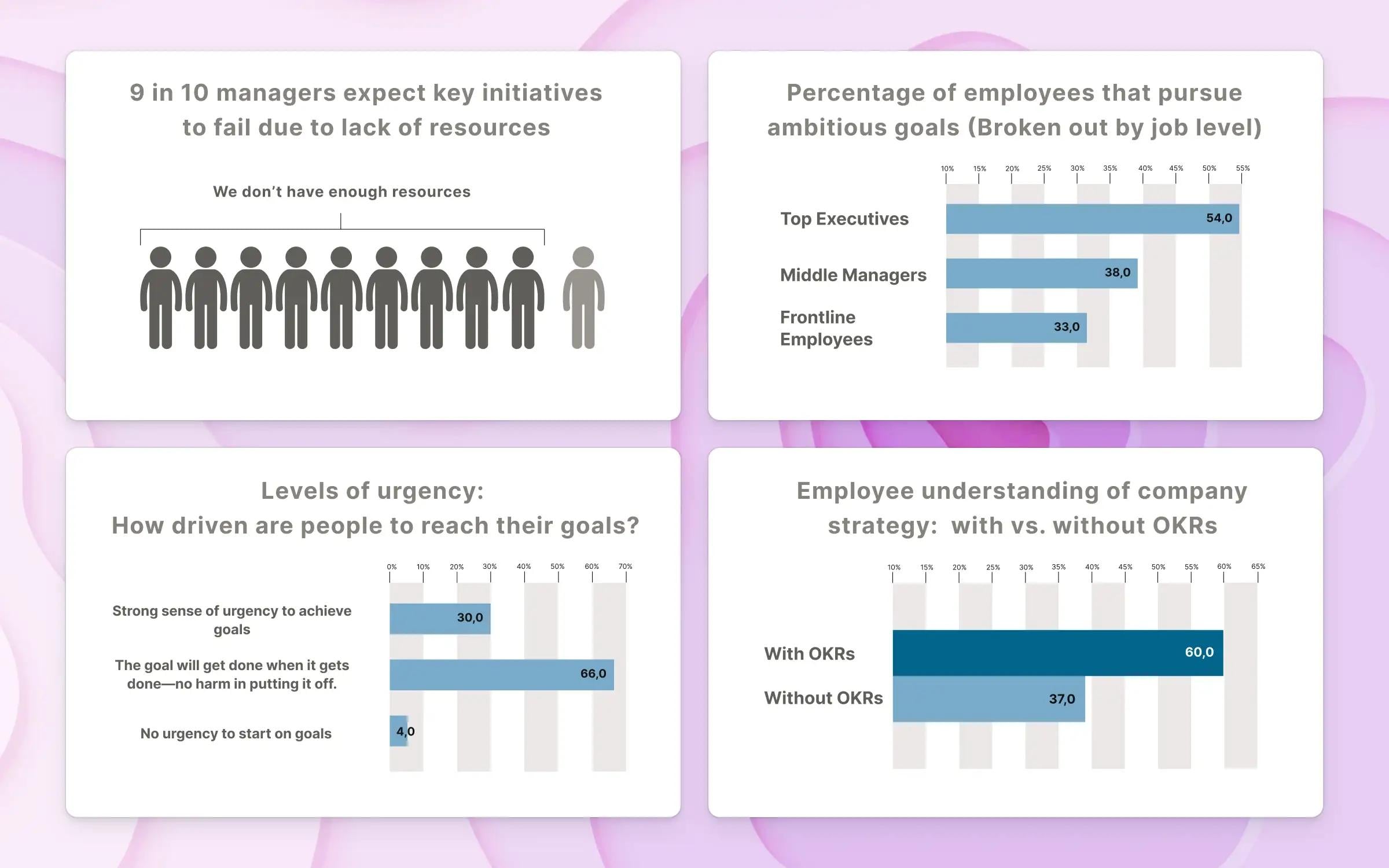
- Although 54% of top executives set difficult or audacious goals, only 33% of frontline employees do the same (Leadership IQ).
- Furthermore, on average, only 43% of people set challenging goals (Leadership IQ), which means that most prefer more comfortable, easy-to-reach targets.
- And only 35% of employees report consistently learning new skills at work, while 52% say they never, occasionally, or rarely engage in skill development. This suggests most employees aren't pursuing challenging goals, instead favoring safe, predictable objectives over those driving growth and innovation (Leadership IQ).
Another common mistake in goal setting is misunderstanding or misusing frameworks designed to facilitate the process. For example, SMART goals provide a structured method for setting clear, actionable objectives, but they are often misapplied or ignored.
- Despite SMART goals emphasizing time-bound objectives, only 30% of participants in a study of 12,801 reported feeling a strong sense of urgency to achieve their goals (Leadership IQ), suggesting that SMART goals are often misapplied.
Similarly, the OKR framework is a powerful tool for helping companies execute their goals effectively. When paired with discipline and clear communication, OKRs can truly drive measurable progress.
- For instance, at Sears Holdings, call-center agents who used OKRs averaged an impressive 8.5% lift in sales per hour (from $14.44 to $15.67), according to the company's own study of 18 months of OKR use across a rollout to roughly 20,000 employees (Sears Holdings study, via Ben Lamorte).
- Moreover, over 60% of companies that successfully implement OKRs conduct regular check-ins at least bi-weekly, ensuring alignment and sustained momentum (OKR Impact Report 2022).
That said, some companies struggle to fully leverage OKRs, due to misunderstandings or improper use of the framework.
- Common issues include misunderstanding how to separate OKRs from day-to-day operations and ensuring proper alignment between teams (OKR Impact Report 2022).
- Additionally, successful implementation relies heavily on executive buy-in, underscoring the importance of leadership commitment to drive organization-wide adoption (OKR Impact Report 2022).
💡 Want to get the most out of OKRs? Check out our article and avoid the most common OKR pitfall to give yourself the best chances of success.
Being stuck in your ways can also be a real goal killer. It’s good to have a plan but you should remain flexible. When obstacles pop up, adjusting course is key, but too many people stick to the original plan and miss out on better opportunities.
- In fact, only 15% of middle managers anticipate and avoid conflicts (HBR, 2015).
- And Just 26% resolve conflicts quickly and effectively (HBR, 2015).
- The majority, however, either take too long to address issues (37%), ignore them (12%), or try but fail to resolve them (10%) (HBR, 2015).
Many companies also fail to align their goals with their overall strategy and rarely revisit them for necessary adjustments. This not only hinders progress but also leads to a lack of transparency across the organization.
- Only 51% of companies even attempt to develop aligned goals, and among the companies surveyed, only 6% regularly revisit them (Zender, 2020).
- And 80% of organizations fail to track their business goals (Zender, 2020).
Companies frequently struggle to allocate resources effectively when setting goals. This can result in either overextending or under-resourcing initiatives, both of which diminish the likelihood of success.
- Only 11% of the managers surveyed by HBR believe their company’s strategic priorities are fully supported by the necessary financial and human resources for successful execution (HBR, 2015).
- And only 20% of managers are confident in their organization's ability to shift personnel across units: it's clear that many companies struggle to adapt their workforce and resources to meet shifting strategic needs (HBR, 2015).
These statistics reveal a significant disconnect between the potential of goal setting and how it’s actually implemented. While goal setting has the power to drive performance, common pitfalls (like opting for easier goals) and lack of alignment across teams diminish its effectiveness.
Now, let’s explore how exactly these pitfalls lead to negative outcomes.
Goal management statistics: The dangers of poor goal setting
Poorly set goals, shaped by the previously mentioned pitfalls, are often destined to fail from the outset as they rarely reach successful completion. This is a challenge many organizations struggle with.
- Only about one-fifth of organizations achieve 80% or more of their strategic targets, underscoring the broader issue of ineffective goal setting and management, according to a global executive survey by Harvard Business Review Analytic Services and the Brightline Initiative (Brightline, sponsored content on HBR, 2019).
But how exactly do the previously mentioned pitfalls affect goal setting and management?
First, a lack of clarity often leads to distrust and internal conflict, which significantly hinders goal progress and wastes valuable time.
- For example, HBR’s ongoing research shows that conflicts and mistrust delay goal execution 38% of the time, and in some cases, these issues are resolved quickly but with poor outcomes (~14%). Meanwhile, roughly 12% of the time, these conflicts remain unresolved (HBR, 2015).
- Unclear objectives are a leading cause of failure. In PMI's 2017 Pulse of the Profession, a lack of clearly defined and/or achievable milestones and objectives to measure progress was the most important factor behind failed strategic initiatives, at 37% (PMI, 2017).
Another common pitfall is the tendency to avoid challenging goals, which can severely limit innovation and growth within an organization.
- For instance, in environments where the emphasis is placed on output rather than meaningful outcomes, 66% of managers tend to recommend setting easier, more attainable goals to avoid failure. This cautious approach, while seemingly safe, often stifles both innovation and growth, limiting the organization's potential to push boundaries and drive progress (HBR, 2015).
However, setting overly ambitious goals can backfire as well. When organizations overestimate their capabilities, it often results in employee burnout and frustration. Failing a goal that was set too high can hurt how people feel and what they do next.
- Goal-setting researchers Locke and Latham (1990) advised setting high, specific goals that only 10% of people can reach, which leaves 90% to face failure, as Höpfner and Keith point out (Höpfner & Keith, 2021).
- In two experiments with 271 participants in total, people who failed a high, specific goal reported lower affect, self-esteem and motivation than people who attained it (Höpfner & Keith, 2021). This highlights the risk of setting difficult goals, despite the potential for high rewards.
- Failing also took an emotional toll: in the first experiment, participants who failed rated their mood 0.67 points lower than those who reached the goal, on a 7-point scale with items running from "tense" to "relaxed" (Höpfner & Keith, 2021).
- Motivation dropped as well, by 0.21 points on a 5-point scale with items such as "I try everything to attain my goals" (Höpfner & Keith, 2021).
- In the second experiment, 88.9% of participants who had failed the goal chose the medium-difficulty task over the very difficult one, compared with 36.6% of those who had reached it (Höpfner & Keith, 2021).
- Aggressive performance goals can also foster unethical behavior. Max Bazerman, a co-author of the "Goals Gone Wild" paper, puts it this way: when employees care only about reaching a goal and bad things can happen if they fail, cheating goes up (HBS Working Knowledge, 2009).
Ultimately, balance is key: goals should stretch an organization’s capabilities without being unattainable. Clear, structured goals rooted in realistic outcomes are critical for fostering both innovation and sustained progress.
A commonly overlooked pitfall is poor resource management, which is more widespread than many might think.
- In fact, 9 in 10 managers expect some of their organization’s key initiatives to fail due to insufficient resources, directly impacting strategic goal completion (HBR, 2015).
On the same note, resource mismanagement often goes hand in hand with a lack of adaptability. After all many businesses are rigid, hesitant to make timely adjustments.
- As a result, 8 out of 10 managers report that their companies are slow to exit failing ventures, wasting resources and missing opportunities for strategic realignment and growth (HBR, 2015).
Additionally, while poor framework execution, such as the misuse of SMART goals and OKRs, may have less severe consequences, it can still lead to missed opportunities and impact the execution of goals.
- For instance, in Sears Holdings' corporate study, employees who used OKRs consistently were 11.5% more likely to move into a higher performance bracket, while using OKRs even once made moving up a performance level 3% more likely (Sears Holdings study, via Ben Lamorte).
To recap, here are the top goal setting pitfalls and their consequences:
- Lack of clarity and understanding: Employees often struggle to fully comprehend organizational goals, creating a disconnect between the company's strategic vision and individual contributions, which hampers motivation and productivity. Only a third of senior managers can name their firm's top three priorities, and in PMI's survey a lack of clearly defined objectives and milestones was the most important factor behind failed strategic initiatives.
- Avoidance of challenging goals: Many employees favor easily achievable goals, prioritizing output over meaningful outcomes. This reluctance to take risks stifles innovation and growth. While 54% of top executives set difficult or audacious goals, only 33% of frontline employees do, and on average only 43% of people set challenging goals at all.
- Poor resource management: Inadequate assessment and allocation of financial and human resources often lead to unrealistic goals that lack the necessary funding and support, resulting in frustration when objectives cannot be achieved.
- Infrequent reviews & failure to adapt: Organizations frequently fail to review and resist adjusting goals when circumstances change. This rigidity wastes resources and causes missed opportunities for realignment.
- Ineffective use of frameworks: Misapplying frameworks like SMART goals and OKRs reduces their effect: at Sears Holdings, consistent OKR users were 11.5% more likely to move into a higher performance bracket, against 3% for one-time use.
Now that we’ve explored the challenges and consequences of poor goal setting, the next question is: what are the best practices for effective goal management?
Statistics on goal execution: How to properly set and execute goals
Successful goal setting goes beyond merely setting goals. It’s about identifying and managing the right goals that will propel you forward. To boost your chances of success, consider these proven goal setting best practices:
One of the most powerful techniques is writing down and visualizing your goals.
- Writing down goals helps. In Gail Matthews' study at Dominican University, where 149 participants pursued a goal for four weeks, those who wrote their goals down rated their goal achievement 6.44 on average, against 4.28 for those who only thought about their goals (Matthews, Dominican University).
Visualization is equally powerful.
- Employees who use visuals to describe their goals are 52% more likely to love their job compared to those who use only words or numbers (Leadership IQ).
- In a TD Bank survey of 1,127 consumers, people who keep images, photos or vision boards of their goals were almost twice as confident that they would achieve them as people who don't (59% vs. 31%) (TD Bank, 2016).
Additionally, having precise, well-defined goals and routinely tracking your progress is vital for staying on course.
- Accountability adds to the effect: participants who wrote their goals and sent weekly progress reports to a supportive friend achieved significantly more than every other group, with an average goal-achievement rating of 7.6, against 4.28 for those with unwritten goals (Matthews, Dominican University).
- Sharing helps, too: those who sent their goals and action commitments to a friend accomplished significantly more than those who only wrote action commitments or did not write their goals down (Matthews, Dominican University).
- Moreover, those who review goals quarterly generate 31% greater returns than those who review goals annually (Forbes, 2018).
- Feedback is also key: employees are more committed to their goals when they receive regular feedback on their progress (Pramanik et al., 2022).
- How often you check progress matters as well: companies that check in on their OKRs weekly or every two weeks rate OKR impact 3.6 and 3.8 out of 5, against 2.6 for monthly check-ins, yet only 83 of the 187 companies (44%) check in every week or two (Mooncamp OKR & Strategy Execution Report 2026).
Clear and time-bound goals are important, but they aren’t enough on their own. To truly drive action, your goals must also be relevant and compelling enough to spark motivation.
- Without urgency, even the best-set goals can falter. Around 70% of people report some form of procrastination. And 94% report that procrastination negatively affects their happiness. A lack of urgency or relevance can significantly hinder progress, productivity, and morale (Leadership IQ).
It also helps when people see what reaching a goal will do for them.
- In a 10-week field study with 41 typists, difficult goals led to higher performance, and goal setting improved performance most for employees with high self-esteem or who saw reaching the goal as a way to earn extrinsic rewards (Yukl & Latham, 1978).
Involving employees in the goal setting process can promote clarity but also fosters innovation by encouraging ownership and collaboration.
- In a survey of 101 employees at four-star hotels in Belitung, Indonesia, taking part in goal setting was linked to innovative work behavior, with feedback from superiors moderating that link (Pramanik et al., 2022).
- With OKRs, too, involving teams goes with higher scores: companies where leaders set the priorities and teams propose their own OKRs score 3.4 out of 5 on executing strategy and 4.0 on team focus, against 2.4 and 2.9 at companies that hand OKRs down from the CEO, level by level (Mooncamp OKR & Strategy Execution Report 2026).
Remember, goals aren’t set in stone: they can change or lose relevance over time. It's important to stay flexible and adapt as circumstances evolve to ensure your goals remain aligned with your priorities.
- Supervisors who adjust goals according to changing priorities see employees become 6.7 times more motivated to take action (Bi Worldwide).
- Looking back on what worked is a habit of the top performers, too: 88% of the companies with the highest OKR impact in our survey (the top 22%) hold a retrospective after every cycle, against 59% of the other companies (Mooncamp OKR & Strategy Execution Report 2026).
You should also know when to cut your losses.
- HBR’s research underscores the importance of abandoning failing or irrelevant goals. However, ~80% of companies struggle to cut ties with unsuccessful projects, leading to wasted resources and effort (FounderJar).
Also, don’t be afraid to set goals that push employees out of their comfort zones.
- Employees who are always learning new skills are 10 times more likely to be inspired to give their best effort at work than those who never learn new skills (Leadership IQ).
Lastly, goal setting can be challenging, but using a dedicated goal management tool or framework can ease the process and keep you on track.
- A structured framework, such as OKRs, can simplify goal management. 83% of companies recommend the OKR framework for aligning company goals and improving outcomes (Haufe Talent).
- In the OKR Impact Report 2022 companies in the benchmark group achieved a 40% higher impact with a clearly aligned OKR system.
- In our 2022 OKR Impact Report, the highest-impact companies showed 28% higher communication intensity, enhancing collaboration and clarity, measured by the number of channels they used to talk about OKRs (OKR Impact Report 2022).
- The decision-makers surveyed rated their likelihood of recommending OKRs as a management framework at 8.5 out of 10 on average (OKR Impact Report 2022).
So what are the key take away from these statistics?
Conclusion
Goal setting isn’t a one-time task; it’s an ongoing process. Goals should be thoughtfully crafted, aligned with your broader objectives, and flexible enough to remain relevant as circumstances change.
The statistics show that clearly defined, challenging goals (when reviewed regularly) create a roadmap to long-term achievement. Whether you're an individual or leading a team, your goals must align with broader strategic objectives and adapt to changing circumstances.
Take a moment to reflect on your own approach.
- Are your goals aligned with your longterm vision and purpose?
- Do they inspire you to push beyond your comfort zone?
- Are you regularly reviewing and adjusting them?
If not, it may be time to refine your goal approach. After all, goals are dynamic, not static: they should evolve with you.
To help you stay focused and organized, consider using goal management tools that simplify tracking and adjustment.
If you’re looking for more inspiration and expert advice head over to our blog for insights on effective goal setting, fostering team alignment, driving operational excellence, and more.
Goal setting statistics: FAQ
Why do goals need to be challenging but realistic?
What are some common mistakes to avoid when setting goals?
How does involving employees in goal setting improve outcomes?
How often should I review and adjust my goals?
What's the difference between setting goals and managing them effectively?
What tools can help with goal setting and management?
What is the best goal-setting framework for remote teams?
Alternatively, SMART goals are also effective for providing structure in remote work.