You have to set goals if you want to be successful. You can do this in many different ways – and not all of them are equally effective. The reason for this are usually the goals themselves: The way a goal is formulated influences how likely it is to actually be achieved. In other words, anyone who sets goals can also make a lot of mistakes. After all, goals can be too unrealistic, too soft, too unspecific, without a target date – and so on. However, simply working without goals isn't a solution either. Instead, write SMART goals.
Some of you may have already heard of these five letters – for everyone else, we'll shed some light on them in this article: We reveal what “SMART” stands for, how the SMART goal framework works and which criteria you should consider when setting smart goals. We also clarify what the SMART framework actually has to do with OKRs.
- Five letters, one rule: SMART goals are Specific, Measurable, Achievable, Relevant, and Time-bound, the five criteria that turn a vague intention into a goal teams can actually hit.
- Origin story: The acronym comes from a 1981 Management Review article by George T. Doran; the research on why specific, difficult goals work comes from Locke and Latham's separate goal-setting theory.
- Watch the trade-offs: Insisting on "achievable" goals can quietly cap ambition, which is one reason to pair SMART with stretch goals such as OKRs.
- SMART fits inside OKRs: The SMART criteria map cleanly to the Key Results layer, so the two methods complement each other rather than compete.
What to expect:
- What are SMART goals? Definition
- Why is it important to set SMART goals?
- Setting goals the SMART way – that's how it works
- SMART goal examples
- SMART goals: advantages and disadvantages
- OKRs and SMART goals: similarities and differences
- Conclusion: SMART is more of a guideline and OKR is a whole framework
- SMART goals – FAQ
What are SMART goals? Definition
SMART goals are objectives written to be Specific, Measurable, Achievable, Relevant, and Time-bound. The acronym is a checklist for goal setting that turns vague intentions into objectives teams can actually act on and track.
“SMART” stands for the first letters of five criteria for setting objectives: Goals should always be
- Specific,
- Measurable,
- Achievable,
- Relevant,
- Time-bound
in order for them to have the most impact and be accomplished.
SMART first appeared in November 1981, in a short Management Review article by George T. Doran, where the letters stood for specific, measurable, assignable ("specify who will do it"), realistic and time-related (Doran, Management Review, 1981). Later versions swapped in "achievable" and "relevant", which is why several readings of the acronym are in use today (Wikipedia, SMART criteria). In the meantime, SMART goals have proven their worth in the management world.
Why is it important to set SMART goals?
People generally base their actions on goals, both in their private lives and at work. True to the motto: You can't achieve what you don't strive for. In companies, goals provide the necessary frame for employees to be motivated and committed to their jobs and to use their skills for the benefit of the company. Moreover, only by setting goals can business owners track progress and determine if their team is truly successful.
That means:
- Goals provide orientation.
- Goals define success.
- Goals drive people.
- Achieving a goal creates satisfaction.
As a manager, setting a rough direction and then hoping that all employees will do their best is by no means enough. Locke and Latham knew this as early as 1990. The evidence for this comes from psychologists Edwin Locke and Gary Latham, whose goal-setting research developed separately from the SMART acronym. Summing up 35 years of studies, they reported that specific, difficult goals consistently led to higher performance than urging people to do their best, with meta-analytic effect sizes of 0.42 to 0.80 (Locke and Latham, 2002). Their goal-setting theory also names commitment to the goal, feedback on progress and the complexity of the task as conditions that shape this effect, so it overlaps with SMART but is not the same list. For a wider view on what the data says, see our roundup of goal-setting statistics.
Setting goals the SMART way – how it works
But how exactly do you set a SMART goal? The principle is clear: Goals work best when they are specific, measurable, achievable, relevant and time-bound. Accordingly, every goal should be based on these criteria. Some versions use other words for a few letters, such as Doran's original "assignable" and "realistic".
Here is what each of the five SMART criteria means in practice:
1. Specific
Goals should be worded as precisely as possible. There should be no doubt about what you want to achieve. Goals should not be formulated too vaguely, yet at the same time also not consist of descriptions that go on for ages. It is best if a goal can be succinctly summarized in a single sentence. Ideally, this sentence should be phrased in a positive way. An example of such a sentence might look like this: “We want to attract 40 percent more visitors to our website in the next six months.”
2. Measurable
In order to be clear in retrospect whether you have achieved a specific goal, you should set measurable goals. They therefore should always be worded in such a way that their achievement can be objectively verified. In other words, the wording should include quantitative metrics (as in the example above) or, alternatively, qualitative metrics (such as customer or employee satisfaction) that can be used to track progress toward achieving a smart objective.
3. Achievable
An achievable goal is one the team can reach with the skills, people, budget and time it actually has. Goals are only achievable if employees are willing to put them into practice. However, there is hardly any goal that is easy to accomplish. Setbacks and challenges are normal. That's why you should make sure to always set an achievable goal, that is, at the same time, appealing, motivating, desirable (i.e., attractive), and enough to motivate the team all the way and overcome challenges. Achievable does not mean easy. In Locke and Latham's research, performance kept rising with goal difficulty and only leveled off or dropped when people reached the limits of their ability or lost commitment to a very hard goal (Locke and Latham, 2002). So set the goal high, but within reach. If the big goal is out of reach for now, break it into smaller, achievable goals that add up to it.
4. Relevant
A relevant goal serves a priority of the team or the company. Before you commit to it, ask which company goal it moves forward and why it matters now. A goal can be specific, measurable and achievable and still pull time away from the work that matters most if it doesn't connect to a priority.
5. Time-bound
Every good goal also needs a certain time frame or a goal deadline. Setting a time limit or date helps with performance management and is important for monitoring success. Additionally, it drives employees: in the studies Locke and Latham summarize, tight deadlines led to a faster work pace than loose ones, both in the laboratory and in the field (Locke and Latham, 2002). This is because deadlines create a sense of urgency. A deadline also keeps a goal in focus between numerous routine tasks.
Five W-questions to specify a SMART goal
Another part of SMART is that anyone who deals with SMART goals will sooner or later find that they are quite complex – and can be broken down into further sub-goals after the initial idea. This is where the following five W-questions come into play. They can really help with specification of the goal:
- What do you want to achieve?
- Why do you want to achieve it?
- Who is involved?
- Where is the goal to be achieved?
- Which are the requirements or constraints?
These questions ensure that nothing is forgotten in the process of setting smart objectives, that everything remains transparent and that, in the end, everyone involved has a clear understanding of the goals.
SMART goal example
What do SMART goals look like in practice? We have an example for you, of course:
“Increase sales” is probably at the top of most entrepreneurs' to-do list. As a goal, however, this is way too general. A better wording according to SMART would be:
„We increase gross sales for cornflakes in the fourth quarter by 10 percent compared to the previous year.“
Formulated this way, the goal is specific (gross sales for cornflakes), measurable (gross sales compared to the previous year), achievable (a 10 percent increase, which the team can plan for with its current resources), relevant (cornflakes sales feed the company's revenue goal) and time-bound (fourth quarter).
SMART goals: advantages and disadvantages
We have already explained why SMART goals are important. Below you will find an overview of the most important advantages:
- Implementation becomes easier. Because SMART goals are so specific, they provide a good basis for an action plan. Everyone involved in a project knows exactly what they should accomplish and by when.
- Priorities are clearer. With SMART goals, it's easier to set priorities and decide what's important – and what can possibly wait.
- Successes are more likely. Goals that are specific, measurable, achievable, relevant, and time-bound can be clearly reviewed. Employees know at all times whether or to what extent they have accomplished a goal. This makes it more likely for them to stay motivated and committed to working toward it.
But as we all know, all that glitters is not gold. Of course, SMART goals also come with some drawbacks:
- Mediocrity is promoted. Because every goal is supposed to be achievable, among other things, many employees and entrepreneurs tend to remain too down-to-earth and do not pursue visionary ideas.
- Motivation can drop. If goals are not set ambitiously enough, one waits in vain for the motivating effect.
- The pressure to perform can grow. Goals of all kinds (so this problem is not SMART-specific) can lead to employees feeling pressured to deliver as highly as possible. However, a healthy and constructive error culture is a good way to mitigate this.
OKRs and SMART goals: similarities and differences
You might be wondering what all this has to do with OKRs? Well, we are going to tell you.
Objectives and Key Results (OKRs for short) and SMART goals are both strategies that help companies or even individuals to set goals in a meaningful way. At first glance, SMART and OKRs seem very similar. Nevertheless, there are also some differences between the two methods.
By the way, in case you want to refresh your OKR knowledge before we dig deeper, simply check out our OKR-Guide.
Similarities between OKRs and SMART goals
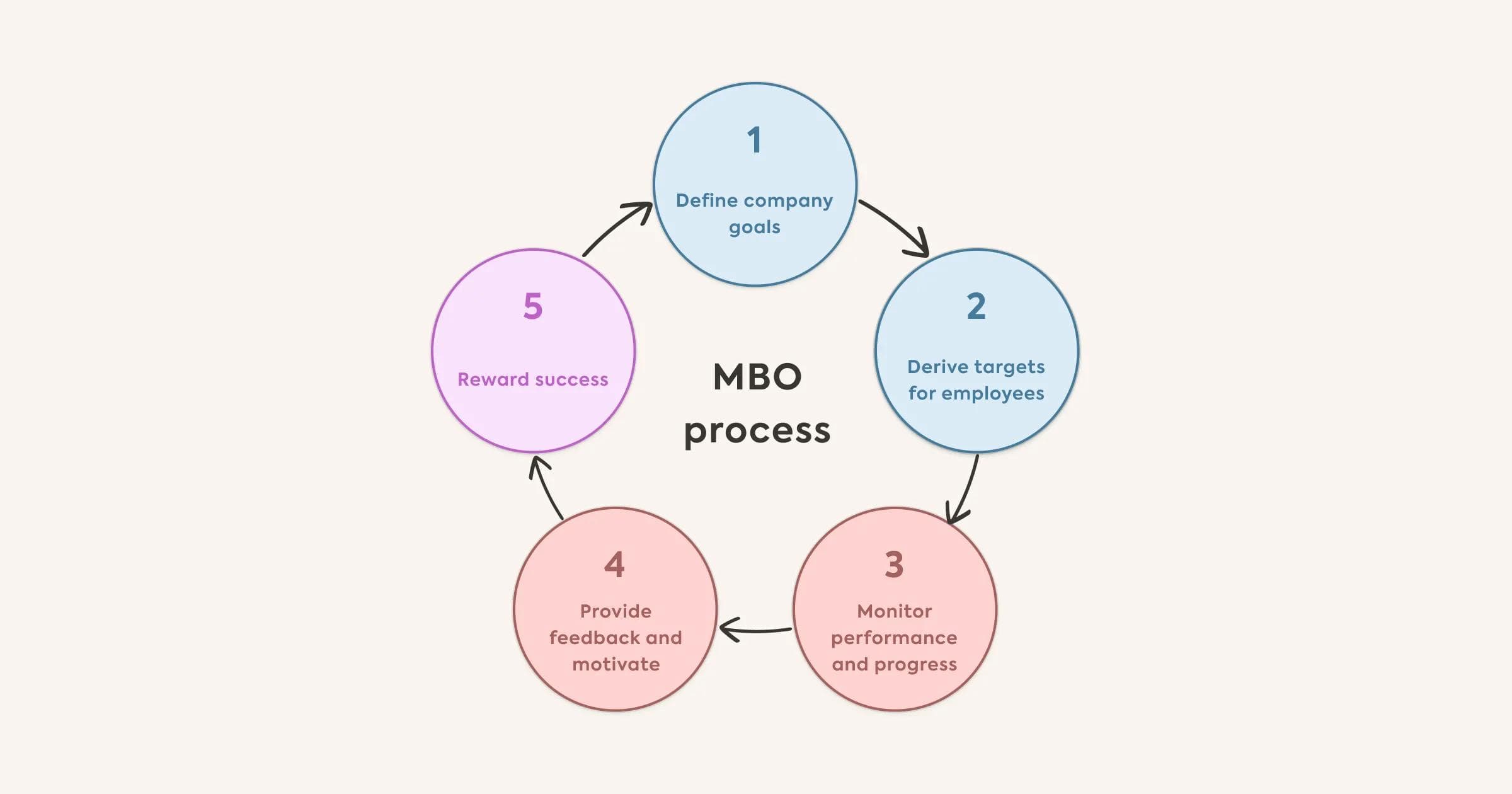
The first commonality between OKRs and SMART is their history: both methods trace their origins back to Peter Drucker's Management by Objectives (MBO), and their basic tenets assume that goals are the key to business success. They both work on a wide variety of levels: for companies, teams and individuals, in a professional context or in a private setting.
OKRs and SMART goals both rely on criteria that make a goal precise and checkable. They differ on ambition: SMART asks for an achievable goal, while OKRs can be set as stretch goals. Google, for example, sets goals "just beyond the threshold of what seems possible" and expects an average grade of 0.6 to 0.7 across its OKRs (Google re:Work). SMART criteria fit best at the key-result level.
Differences between OKRs and SMART goals
SMART goals tend to be viewed in isolation, while OKRs are usually linked to a company's mission and vision: Several measurable sub-goals (key results) are used to work towards the “big picture” (objective).
OKRs often run in quarterly cycles alongside annual company goals; Google, for example, sets annual and quarterly OKRs (Google re:Work). That ties a short-term target to the bigger picture. A SMART goal describes one target, while an OKR pairs a qualitative objective with several key results that show whether it was reached, and each key result can be written to SMART criteria.
Especially when the “m” in SMART is understood as “motivated” rather than “measurable”, OKRs and SMART can diverge widely. While SMART is often interpreted differently depending on which person or team is working with it, the meaning behind the three letters “OKR” always remains the same: Objectives and Key Results.
Conclusion: SMART is more of a guideline and OKR is a whole framework
In summary, SMART goals and OKRs are both very effective strategies for goal setting – which differ essentially in how comprehensive they are. They both aim for different things, but can also complement each other well for that very reason: While SMART goals focus on the structure of a single goal and provide a guideline to properly formulate goals, OKRs present an entire framework right away, linking individual key results to a company's overarching strategy.
SMART goals can easily be applied within the OKR framework – namely when it comes to defining meaningful key results. For a deeper walkthrough of writing strong objectives and measurable key results, see our guide on how to write OKRs. SMART is basically an important piece of the puzzle in a larger framework that would be incomplete when considered on its own from today's perspective.